How to Capture a Client's Voice (So AI Can Actually Use It)
Most ghostwriters describe client voice with adjectives like 'professional but approachable.' That's not a voice—it's a vibe. Here's a systematic approach to capturing voice in ways that actually transfer to AI-assisted content creation.
Writesy AI Team
Writesy Editorial

TL;DR
Capturing a distinctive brand voice requires documenting specific patterns—vocabulary, structure, and opinions—rather than relying on vague adjectives that lead to generic content. This post presents a 5-phase framework: gathering source material, deep pattern analysis, voice interviews, building a comprehensive reference document, and configuring AI tools. The result is an actionable brand voice guide that ensures consistency, authenticity, and enables AI to produce content that genuinely sounds like the client, building trust and commanding higher rates.
TL;DR: Capturing a client's voice for AI ghostwriting requires documenting specific patterns, not vague adjectives. This 5-phase framework covers gathering source material, analyzing vocabulary/structure/opinions, conducting voice interviews, building a reference document, and configuring AI tools. The result: an AI ghostwriter setup that produces content sounding like the client, not like a chatbot.
This tutorial walks through a complete voice capture process—from gathering raw materials to producing documentation that actually guides content creation. I've refined this approach over dozens of client engagements, though I should note upfront that some parts will need adapting to your specific workflow.
Marketers using AI for content creation consistently point to maintaining brand voice as one of their biggest challenges. The root cause isn't the AI—it's that voice was never properly documented in the first place.
Before We Start: The Adjective Problem
Let me show you what doesn't work, because I've made this mistake plenty of times.
| How Ghostwriters Describe Voice | Why It Fails |
|---|---|
| "Professional but approachable" | Describes 90% of B2B executives |
| "Authoritative but not stuffy" | Too vague to guide word choice |
| "Expert without being intimidating" | No actionable patterns |
| "Warm and conversational" | Doesn't distinguish from competitors |
Feed those adjectives to an AI tool. You'll get generic content that sounds like everyone else trying to sound "professional but approachable."
Voice isn't a collection of adjectives. It's a set of specific, documentable patterns. This tutorial teaches you to capture those patterns.
What You'll Build
By the end of this process, you'll have:
| Deliverable | Purpose | Format |
|---|---|---|
| Vocabulary inventory | Captures signature words/phrases | Spreadsheet or table |
| Structure analysis | Documents sentence and paragraph patterns | Notes with examples |
| Opinion map | Records consistent beliefs and stances | Bullet list with quotes |
| Avoidance list | Identifies what they never say | Do-not-use checklist |
| Voice document | Consolidates everything | Reference document |
| Tool configuration | Makes voice usable in AI tools | Platform-specific |
Let's work through each piece.
Phase 1: Gathering Source Material
You can't analyze what you don't have. Start by collecting everything the client has written or spoken.
Written Sources to Request
| Source Type | Value | Where to Find |
|---|---|---|
| Published articles (bylined) | High—shows intentional voice | Personal website, Medium, industry pubs |
| LinkedIn posts | High—shows casual voice | LinkedIn profile |
| Email threads | Medium—shows unpolished voice | Ask permission |
| Internal presentations | Medium—shows how they explain things | Client's files |
| Old website copy | Variable—may be outdated | Wayback Machine if needed |
Spoken Sources to Gather
| Source Type | Value | Where to Find |
|---|---|---|
| Podcast appearances | Very high—extended unfiltered voice | Search "[name] podcast" |
| Conference talks | High—polished but authentic | YouTube, Vimeo, conference sites |
| Interview transcripts | High—responsive voice | PR materials, media coverage |
| Meeting recordings | Medium—conversational voice | Ask permission |
I try to get at least three written pieces and two spoken pieces before starting analysis. More is better, but don't let perfect be the enemy of good—you can refine the voice document later as you gather more material.
Phase 2: Pattern Analysis
Now comes the actual work. You're not reading for content—you're reading for patterns.
Step 2.1: Build the Vocabulary Inventory
Go through each source and extract words and phrases that recur or stand out.
| Pattern Type | What to Capture | Example Entries |
|---|---|---|
| Industry terms | Jargon they use (or avoid) | "Uses 'users' never 'customers'" |
| Metaphors | Recurring imagery | "Always compares to building/construction" |
| Quantifiers | How they express scale | "Says 'several' not 'a few'" |
| Intensifiers | How they emphasize | "Uses 'genuinely' and 'actually'" |
| Transitions | How they connect ideas | "Starts sentences with 'Look,' and 'Here's the thing'" |
| Branded phrases | Signature expressions | "Calls this 'the compound effect'" |
Build a running list. 20-30 entries minimum. I've found that vocabulary is where most of the distinctive voice lives—capture it thoroughly.
Step 2.2: Document Structure Patterns
How does this person build sentences and paragraphs?
| Structural Element | Questions to Answer | Notes Format |
|---|---|---|
| Sentence length | Short and punchy? Complex and nested? Mix? | "Mostly short (8-12 words), occasional long for emphasis" |
| Paragraph length | How many sentences per paragraph? | "2-4 sentences, never more than 5" |
| Opening moves | How do they start pieces? Sections? | "Opens with a direct statement, not a question" |
| List usage | Bullets? Numbers? Inline? | "Uses bullets for options, numbers for sequences" |
| Rhetorical questions | Frequent? Rare? Never? | "Uses rhetorical questions to introduce topics" |
Step 2.3: Map Their Opinions
Voice includes what someone believes, not just how they say it.
| Opinion Category | What to Document |
|---|---|
| Hills they'll die on | Non-negotiable beliefs they express repeatedly |
| Rejected conventional wisdom | Industry "truths" they push back against |
| Causes they champion | Topics that make them passionate |
| Industry frustrations | What annoys them about their space |
The opinions are important because content that reflects their actual views sounds more authentic than content that just mimics their syntax.
Step 2.4: Build the Avoidance List
Sometimes what someone doesn't say is as telling as what they do say.
| Avoidance Type | Examples |
|---|---|
| Forbidden words | "Never uses 'leverage' as a verb" |
| Off-limits topics | "Won't comment on competitor products" |
| Stylistic taboos | "No exclamation points ever" |
| Tone boundaries | "Never sarcastic about customers" |
Phase 3: The Voice Interview
Source material shows how they write when they're trying. An interview shows how they think when they're not.
Questions That Actually Work
I've tried a lot of voice interview questions. These consistently produce useful insights:
| Question | What It Reveals |
|---|---|
| "When you read content in your industry, what makes you think 'this person gets it'?" | Quality standards and preferences |
| "What writing tics annoy you?" | Avoidances and pet peeves |
| "Who do you admire as a communicator? Why?" | Aspirational voice models |
| "What topics are you tired of seeing covered badly?" | Opinion patterns and frustrations |
| "What would someone who disagrees with you say?" | Self-awareness about positions |
| "How would you explain what you do to someone outside your industry?" | Plain language patterns |
| "What's a belief you hold that most people in your field don't?" | Distinctive opinions |
A quick reflection here: I've found that the last question—about contrarian beliefs—often produces the most distinctive voice material. If someone doesn't have any contrarian views, their voice will probably be harder to distinguish from the generic industry voice. That's useful information too.
Phase 4: Building the Voice Document
Now consolidate everything into a reference document. Structure matters—you'll use this constantly.
Recommended Document Structure
| Section | Contents | Length |
|---|---|---|
| Quick Reference | 2-3 sentence summary for fast orientation | 50 words |
| Vocabulary | Specific word preferences with examples | 1-2 pages |
| Style Patterns | Sentence/paragraph structure notes | Half page |
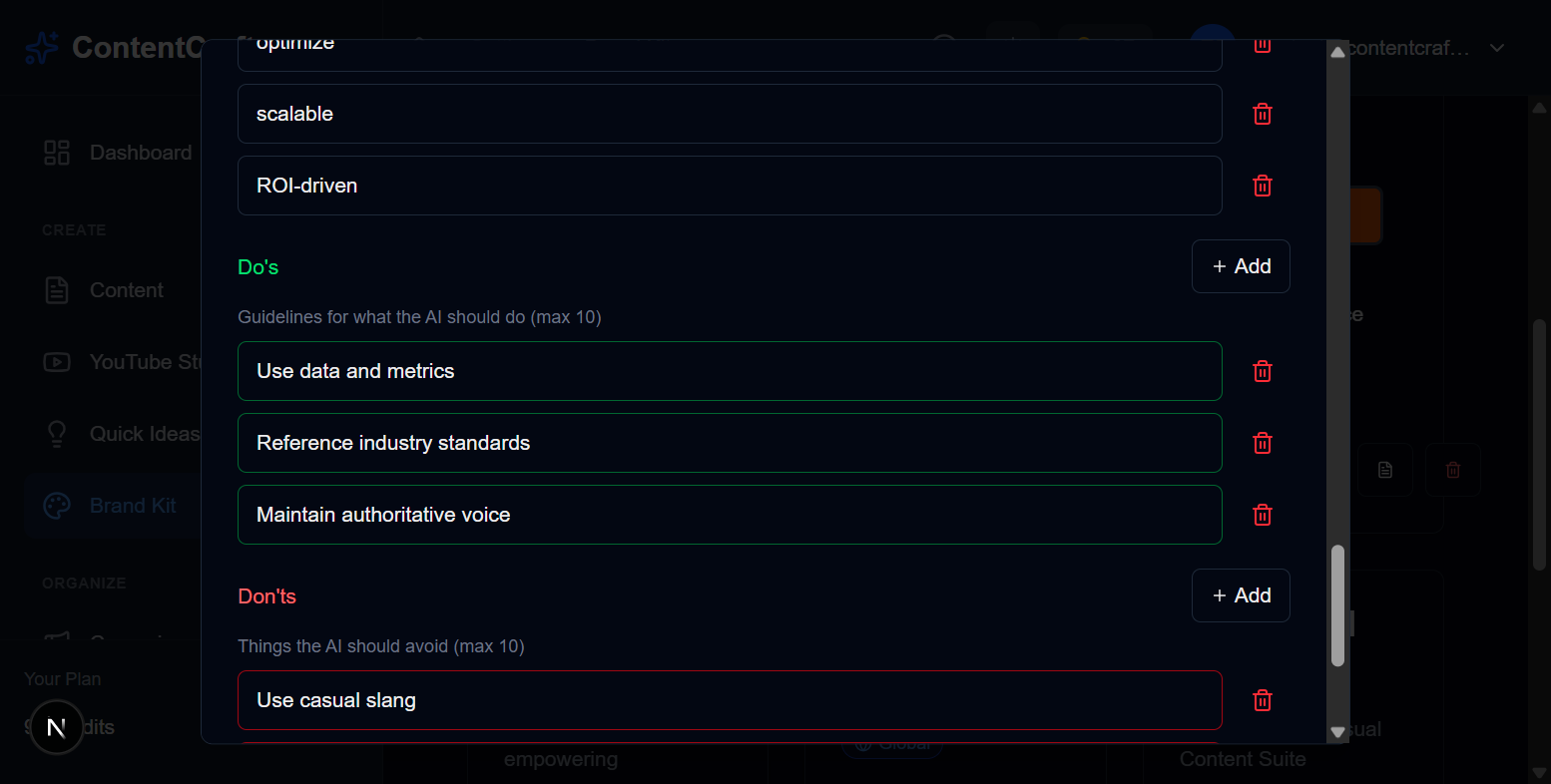
| Do's | Active guidance for content creation | 10-15 bullets |
| Don'ts | Things to avoid | 10-15 bullets |
| Sample Library | 3-5 links to content they love | Links + notes |
Example Do's Section
Here's what a real do's section might look like:
- Use "clients" not "customers"
- Include specific metrics when making claims
- Reference recent industry trends
- Use direct address ("you") frequently
- Start pieces with a concrete observation, not an abstract statement
- Use "building" and "shipping" metaphors for product development
- Attribute insights to specific experiences when possible
Example Don'ts Section
And a real don'ts section:
- No buzzwords: synergy, leverage (as verb), paradigm, bandwidth (for capacity)
- No exclamation points
- Never criticize competitors by name
- Don't use "I think" hedging—state opinions directly
- Avoid starting sentences with "As a [role]..."
- No emoji in professional content
- Don't use "utilize" when "use" works
Phase 5: Making Voice Usable
A voice document in a Google Doc that gets referenced occasionally isn't a system. Under deadline pressure, you'll skip it. I know because I've done exactly that.
The goal is making voice patterns accessible at the moment of creation.
For Human Writers
| Tool | Purpose | When to Use |
|---|---|---|
| Pre-write checklist | Orient yourself before drafting | Start of each piece |
| Do's/don'ts card | Quick reference during writing | Keep visible while working |
| Sample library | Remind yourself of the target | When stuck or uncertain |
| Review rubric | Check content before delivery | Final review |
For AI-Assisted Creation
Modern AI tools let you configure voice at the system level:
| Configuration Element | What to Include |
|---|---|
| Tone settings | High-level personality descriptors |
| Vocabulary preferences | Specific word choices (use X not Y) |
| Do's | Patterns to follow |
| Don'ts | Patterns to avoid |
| Sample content | Examples that show the target voice |
The more specific your configuration, the closer AI output matches actual voice. Generic tools ask for "tone: professional." Better tools let you specify the full vocabulary and pattern list.
Managing Multiple Client Voices
Here's where things get harder. Switching between clients means switching between entirely different pattern sets.
The Voice Bleed Problem
| Scenario | Risk | Mitigation |
|---|---|---|
| Client A morning, Client B afternoon | B absorbs A's patterns | Full context switch between clients |
| Similar industries | Vocabulary overlap | Document differences explicitly |
| Similar personalities | Style convergence | Focus on opinion differences |
| Rush deadlines | Skip voice reference | Build checking into workflow |
What a Clean Context Switch Looks Like
Before writing for a different client:
- Close all previous client materials
- Open the new client's voice document
- Read through their sample library (2-3 pieces)
- Review their do's and don'ts
- Then start writing
This takes five minutes. It saves hours of revision.
Maintaining Voice Over Time
Voice isn't static. People evolve their thinking.
Review Schedule
| Trigger | Action |
|---|---|
| 6-month mark | Scheduled voice audit |
| Client feedback on tone | Immediate documentation update |
| Client's public positioning changes | Review vocabulary and opinions |
| New content type (podcasts, video) | Gather additional source material |
Handling the "I'd Never Say That" Moment
Sometimes a client will reject something you pulled directly from their previous content. They're not necessarily wrong—voice evolves. But flag it: "You wrote something similar here. Has your perspective changed?"
This often surfaces valuable insights about how they want to be perceived now versus how they presented themselves before. Update the documentation accordingly.
The Complete Checklist
When onboarding a new client, work through this sequence:
Week 1: Gathering
- Request all available source material
- Search for podcast appearances
- Find conference talks or interviews
- Schedule voice interview
Week 2: Analysis
- Build vocabulary inventory (20+ entries)
- Document structure patterns
- Map opinion patterns
- Create avoidance list
- Conduct voice interview
Week 3: Documentation
- Compile voice document
- Build do's list (10-15 items)
- Build don'ts list (10-15 items)
- Curate sample library
- Configure AI tools
Ongoing
- Schedule 6-month voice audit
- Document feedback on specific pieces
- Update as client positioning evolves
Systematic voice documentation is also a pricing lever: the writers who can prove they'll capture a client's voice reliably are the ones who command premium rates, because they're selling a repeatable result rather than a hopeful draft. The investment in voice capture pays for itself within the first few pieces.
The clients who trust that you'll nail their voice—every time, at scale—are the clients who'll pay premium rates and stick around for years. Systematic voice capture is how you build that trust.
Frequently Asked Questions
What is a brand voice guide?
A brand voice guide is a reference document that codifies how a person or company communicates. Unlike style guides that cover grammar and formatting, a voice guide captures vocabulary preferences (words they use and avoid), structural patterns (sentence length, paragraph style), opinion positions (what they believe and push back on), and tone boundaries (what they'd never say). The guide in this article's Phase 4 section provides a template: quick reference, vocabulary inventory, style patterns, do's list, don'ts list, and sample library.
What are the 5 elements of brand voice?
The five core elements: (1) Vocabulary — specific word choices, signature phrases, and avoided terms, (2) Tone — the emotional register (authoritative, conversational, irreverent, measured), (3) Structure — sentence length, paragraph density, list usage, how ideas are organized, (4) Perspective — opinions, beliefs, causes championed, and conventional wisdom rejected, (5) Boundaries — what the voice never does (no exclamation points, no jargon, no competitor criticism). Most voice guides only capture tone—the other four elements are where distinctive voice actually lives.
What are the 3 C's of brand voice?
The 3 C's are typically defined as Consistency (the voice sounds the same across all channels and content), Clarity (the voice communicates without ambiguity or unnecessary complexity), and Character (the voice has distinctive personality that differentiates from competitors). For ghostwriting specifically, character is the hardest to transfer—it requires the specific vocabulary, opinions, and structural patterns documented in this article's Phase 2 analysis.
How do you capture someone's voice for writing?
The systematic approach covered in this article: (1) Gather source material — collect 3+ written pieces and 2+ spoken pieces (podcasts, talks), (2) Analyze patterns — build vocabulary inventory (20+ entries), document structure patterns, map opinions, create avoidance list, (3) Conduct a voice interview — use questions that reveal how they think when not performing, (4) Build the reference document — consolidate into do's, don'ts, vocabulary, samples, and quick reference, (5) Make it accessible — configure it into your writing tools so it's available at the moment of creation, not buried in a Google Doc.
Writesy AI supports systematic voice capture with brand kits that store vocabulary, tone settings, and do's/don'ts at the project level. Explore voice-first brand kits →